Gskyer 70mm Telescope Review (AZ70400): Is This Best-Seller Worth Your Money?
Spend five minutes browsing starter telescopes online, and the Gskyer AZ70400 will show up again and again. It’s a compact 70mm refractor on a simple alt-azimuth mount; it comes with a surprising pile of accessories, and the price is hard to argue with. That kind of popularity makes a skeptic curious. Is it a bargain, or just a well-marketed box of plastic?
See also:
In this review, I’ll walk through what works, what doesn’t, how it’s set up, what you can realistically see through it, and who should (and shouldn’t) put it on a shopping list.
The quick take: The Gskyer is a good fit for kids and first-timers on a tight budget. The optics are respectable for the price, but adults will find the tripod too short, and the accessories are sort of iffy. Think of it as a low-risk way to find out whether you enjoy stargazing.
Link for the product below:
(See related reading on our site: best portable telescopes for camping, best telescopes under $100, and best telescopes for astrophotography.)
Specs
- Type: Refractor
- Aperture: 70mm, glass lens, fully coated
- Focal length: 400mm (f/5.7)
- Eyepieces: Two Kellner eyepieces, 25mm and 10mm
- Magnification: 16x and 40x, or 48x and 120x with the 3x Barlow
- Finderscope: 5×24
- Diagonal: 48° erect image
- Mount: Alt-azimuth with aluminum tripod
- Weight: About 5.7 lbs
- Warranty: Two years
What You Get in the Box
This is where the Gskyer stands out from similar scopes. Along with the telescope itself, you also get:
- A carrying bag that holds the telescope and also the tripod
- An adjustable aluminum camera style tripod that folds down small
- A 3x Barlow lens
- An eyepiece rack that clips onto the tripod
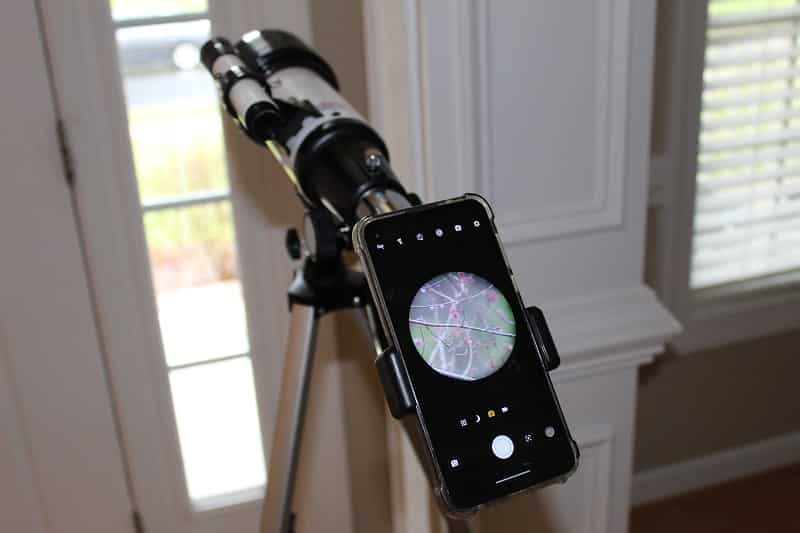
- A smartphone adapter. See image blow.
- A Bluetooth remote shutter for your phone, battery included
- A color, picture-based setup guide
- A lens cloth
- The 5×24 finderscope and its bracket
- The 48° erect-image diagonal

If you priced these extras individually, they’d add roughly $20 to $25 to the cost, which is the main reason this kit beats comparable 70mm scopes on value.
Who Is Gskyer? Can You Trust the Brand?
Gskyer is not a household name in astronomy the way Celestron or Sky-Watcher are, so it is hard to find reliable information about the company. It appears to be a brand name used by a Chinese manufacturer, so it is hard to find English support or contact details for buyers outside China. (For context, many Celestron products are also made in China, so where it’s built isn’t the real issue. Support is.)
So what does that mean for you?
- If you care about a recognisable brand and easy customer service, you’ll probably feel better with Celestron or Orion.
- If you care mostly about price and included extras, the Gskyer is hard to beat for what looks like a nearly identical telescope.
Either way, remember that any telescope under about $100 involves compromises. You get what you pay for, and anyone claiming otherwise is selling something.
What’s Good About It
1. The optics punch above their price. A fully coated 70mm glass objective gives bright, sharp views for its size. It’s enough to see lunar craters, the shapes of the bright planets, and some of the easier deep-sky targets.
2. Excellent value. The telescope plus the starter accessories costs less than a mid-range tablet, and in addition, you can always upgrade parts later.
3. It’s easy for kids to figure out. The design is simple enough that a child can start experimenting with the eyepieces and focus almost immediately, especially in daylight. Dim night targets will require adult help at first.
4. It’s small and light. The tube is short, the whole kit weighs about six pounds, and everything fits in the included bag. See the image below.

5. It’s great for daytime viewing. The erect-image diagonal shows the world right-side up, so pointing at a bird, a treetop, or a distant building feels natural. That’s an underrated feature for beginners, who can practice focusing and aiming before the dark sky makes it harder.
6. It includes phone gear that most competitors skip. The smartphone mount and wireless remote let you take photos without bumping the tripod, and everyone can look at the same image on a screen.
What’s Not So Good
1. A cheaper feel. The Kellner eyepieces are fine for the price, but the Barlow, the finderscope, and the smaller parts are lightweight and made for budget use. Set your expectations accordingly.
2. The eyepieces have a narrow field of view. This is especially true of the 25mm. Finding the right eye position takes practice, and it can frustrate a child or a beginner at first.
3. The tripod is too short for adults. The low height plus the angled diagonal means you’ll be sitting, stooping, or kneeling. Targets high overhead are basically off the table unless you lie on the ground. The Celestron and Orion competitors share this weakness.
4. The instructions only cover assembly. Nothing in the box explains how to actually use the telescope: aligning the finderscope, finding objects, or focusing at night. Many negative reviews online come from people who have simply never learned these basics.
5. The finderscope is nearly useless. It’s plastic, the crosshairs are hard to see in the dark, and getting it perfectly aligned is tricky. Many owners skip it and sweep the sky with the 25mm eyepiece instead. This is a common weakness in budget scopes.
Is the Gskyer 70mm Worth Buying?
If your expectations are realistic, yes, and it’s easy to see why it sells so well. It’s an affordable, friendly entry point that lets a beginner or a child see far more than they can with their eyes alone.
Pros
- Low price with nearly everything needed to start
- Compact, lightweight, and simple to set up
- Great for kids and for daytime nature viewing
- Good views of the Moon, bright planets, and some star clusters
- Bonus phone mount, remote, Barlow, and eyepiece rack
Cons
- Adults must sit or kneel, and high targets are hard to reach
- Flimsy accessories and a wobbly tripod
- Limited support compared with established brands
If this is a first telescope or a gift, pair it with a beginner astronomy book. It makes a real difference.
Scorecard
| Category | Verdict | Why |
|---|---|---|
| Skill level | Kids and beginners | Aimed at people just starting out |
| Build quality | 3/5 | Built to be light and cheap |
| Ease of use | 4/5 | Very simple, as long as you aren’t aiming straight up |
| Power and clarity | 2/5 | Modest aperture limits detail |
| Control | 3/5 | Basic alt-az mount and tripod |
| Portability | 5/5 | Ultra-light and easy to carry |
| Accessories | 3/5 | Lots included, quality is average |
| Overall value | 4/5 | Strong value for the money |
Using the Gskyer 70mm Refractor
Setup
The first hurdle with any telescope is getting it out of the box and put together. With so few parts, the Gskyer is less intimidating than most. Plan on roughly 5 to 10 minutes. The picture-based instructions are clear, and plenty of video tutorials exist online if you get stuck.
The catch is that nothing teaches you how to use it afterward, which is odd for a scope marketed at beginners and children. If you’re buying for a child, be ready to do some of the research and teaching yourself. The basic routine is simple:
- Assemble everything using the picture guide.
- Align the finderscope during the day.
- Practice swapping eyepieces and focusing before you go out at night.
Eyepieces and Barlow
The 25mm eyepiece gives a wide, low-power view at 16x. It’s ideal for finding objects and for large targets like star clusters. The 10mm eyepiece gives 40x, which brings you closer to the Moon and planets, though you shouldn’t expect fine detail, especially when the atmosphere is unsteady.
The 3x Barlow can multiply those figures to 48x and 120x. Two cautions apply. First, the Barlow is plastic, and images get softer with it in place. Second, a 70mm lens tops out at roughly 137x under perfect conditions (about 50 times the aperture in inches), so 120x is already near the ceiling. It’s still nice to have, especially for the Moon and for watching birds or distant scenery during the day.
The Tripod
The tripod is the weakest link. It’s light, and any vibration shows up in the image. It’s also short, which suits young children but forces adults and teens to sit or crouch. Extending the legs fully makes it even less stable, and because there’s no center column, pointing high in the sky is awkward. It also can’t track objects smoothly as they drift across the sky the way an equatorial mount can.
The good news is that it’s easily replaced. Almost any sturdy camera tripod will work, and using the scope on a solid table helps a lot in the meantime.
Aligning the Finderscope
A finderscope is a small spotting scope mounted on top of the main tube. This one is 5×24, meaning 5x magnification with a 24mm aperture. Aligning it takes a few minutes, and it should always be done in daylight:
- Insert the 10mm eyepiece and point the telescope at a distant, recognizable object, such as a rooftop corner or a treetop down the street.
- Focus until the object is sharp.
- Center it in the eyepiece, then tighten the tripod handle so the scope stays put.
- Without moving the telescope, use the three adjustment screws on the finderscope to center the same object in its view. Refocus the finderscope if needed by twisting its end.
- Check the eyepiece again. If the target isn’t still dead center, repeat the process.
Keep in mind that the finderscope image is inverted, which feels strange at first. Practice finding things in the finderscope and then looking through the eyepiece, using different eyepiece combinations. Dim stars are much harder to find than bright houses and trees, so expect it to take some practice.
What You Can See
- The Moon, Jupiter, and Saturn. Bright, easy targets. You’ll see the Moon’s craters and shadows clearly, and the shapes of the planets, but not fine details like Jupiter’s cloud bands or gaps in Saturn’s rings.
- Brighter deep-sky objects. The Orion Nebula and the Andromeda Galaxy are within reach. Under light-polluted skies, Andromeda will look faint, while Orion is easier to spot.
- Star clusters. The Pleiades and the Hyades are good targets for this scope’s wide field of view.
A 70mm aperture shows glimpses of the biggest, brightest objects, but many faint deep-sky targets will simply be out of reach. [Add your own observations here: which targets you tried and how they looked.]
Phone Adapter and Bluetooth Remote
Few telescopes in this class include phone gear. It lets the whole family look at the same image on a screen, which is especially nice for kids, and it makes snapping a picture of the Moon easy. The wireless remote keeps you from shaking the tripod when you take a photo. It pairs through your phone’s Bluetooth menu, with no instructions needed.
Treat this as a bonus rather than a reason to buy. It’s fun for snapshots but too limited for serious astrophotography.
Simplicity and Convenience
Once you’ve learned the basics, using the Gskyer is simple: mount it, point it, and look. It needs no collimation, which means you never have to realign the mirrors or lenses to get a sharp image. That’s a major advantage for beginners and children, who can quickly give up when a telescope “isn’t working.”
Portability
The telescope and its accessories weigh about six pounds in total, and the tube is about 18 inches long. It fits in the included bag and is light enough for a child to carry. It’s a good choice for camping, hiking, and road trips. The bag doesn’t have pockets for small accessories, so you may want to wrap them in a cloth to stop them rattling around.
Versatility
You can use it for both astronomy and ordinary daytime viewing, such as wildlife, landscapes, and distant buildings. That gives beginners lots of chances to practice, which builds the skills and confidence needed for harder night-sky targets.
Who Should Buy the Gskyer AZ70400?
No telescope is right for everyone. More powerful scopes are heavier, cost more, and demand more skill, while budget scopes limit what you can see. With that in mind, the Gskyer is a good choice for:
- Budget beginners. Under $100 gets you a telescope and accessories, with room to upgrade the eyepieces later.
- Kids. It’s simple, light, and durable enough to survive a few bumps, and you won’t be heartbroken if it gets scratched.
- Families and experienced hobbyists. It makes a fine second scope for friends and relatives when you go stargazing.
- Travelers and campers. It’s compact and cheap enough to take almost anywhere.
It’s not a good fit if you:
- Mainly want to observe faint deep-sky objects. You’d need much more aperture.
- Want fine planetary detail.
- Want tracking or a built-in object database. This is a fully manual telescope.
Alternatives
The closest rivals are the Celestron 70mm Travel Scope and the Orion GoScope III. They’re nearly identical in aperture, focal length, and finderscope. The Gskyer offers more extras, while the others offer U.S.-based support, backpack-style cases, and some software or moon-map extras.
| Category | Gskyer AZ70400 | Celestron 70mm Travel Scope | Orion GoScope III 70mm |
|---|---|---|---|
| Focal length | 400mm | 400mm | 400mm |
| Aperture | 70mm | 70mm | 70mm |
| Optics | Glass, fully coated | Glass, fully coated | Glass, fully coated |
| Bonus items | Phone mount, wireless remote, eyepiece rack, 3x Barlow | Free software download | Orion MoonMap 260 |
| Warranty | 2 years | 2 years | 1 year |
| Support | Limited outside China | U.S.-based | U.S.-based |
| Case | Tote bag | Backpack | Backpack |
| Eyepieces | 25mm and 10mm Kellner | 20mm and 10mm Kellner | 20mm and 9mm Kellner |
| Finderscope | 5×24 | 5×24 | 5×24 |
| Diagonal | 48° erect-image | 45° erect-image | 45° erect-image |
| Tripod | 46″ alt-az | 52″ alt-az | 43.5″ alt-az |
Final Thoughts
The Gskyer AZ70400 removes most of the barriers that keep people from trying astronomy: a high price, complicated setup, collimation, and the fear of breaking something expensive. It’s not a powerhouse, and its accessories reflect its price, but it does what a starter telescope should. It gets someone outside, looking up, and curious.
For a child or a first-timer, it’s a better gift than another gadget that will be forgotten in a month. And if you’ve always wondered whether you’d enjoy astronomy, this is a low-risk way to find out.
Link for the product below: